Introduction
One Friday, a client came to refill their CBD gummies at our store. But they looked tense & asked, “What happens if I stop? Will I have withdrawal symptoms”
That concern is understandable. CBD comes from the cannabis plant, so it is easy to assume that regular use could lead to some kind of dependence.
So, is CBD addictive like THC? Read ahead to find out what the research says.
CBD is not addictive. The World Health Organization classified CBD in 2018 as having no dependence potential and no abuse potential. It is THC that causes the high & the euphoric effect, not CBD. Stopping CBD does not produce withdrawal symptoms.
What addiction actually requires?
Before we jump in to know whether CBD is addictive or not, let’s understand the very core of addiction. It is a chronic brain condition that effectively hijacks the body’s natural survival system. The very brain’s reward circuitry, which evolved to keep us seeking food, water, and connection, gets rewired toward seeking a substance instead.
It has two components. Physical dependence is one part of that picture. It happens when the body adapts to a substance and stopping it causes withdrawal symptoms like sweating, shaking, nausea, anxiety, sleep problems, etc. This is what happens with alcohol, opioids, benzodiazepines, and to some extent, THC. CBD has no effects indicative of physical dependence.
Then comes psychological dependence, which involves craving, compulsive use, and continued use despite harm. By that standard, CBD has shown no signal of psychological dependence in the research literature.
But can a person form a habit around CBD? Yes. The same way they can around a morning coffee, an evening piece of chocolate, or a particular brand of tea. So, not all habits are addictions. Taking a daily supplement at the same time each day is a routine, not dependence.
What does the WHO say about CBD?
If there is one authority worth checking when the question is addiction, it is the World Health Organization (WHO).
In 2018, the WHO reviewed the available evidence on cannabidiol and found no evidence that pure CBD has abuse or dependence potential. It also noted that CBD does not produce the effects associated with THC. That finding was the basis on which the WHO recommended that CBD not be subject to international drug control conventions.
P.S. This is the current global health authority position, and it has not been revised.
CBD vs THC — why one is habit-forming and the other isn't?
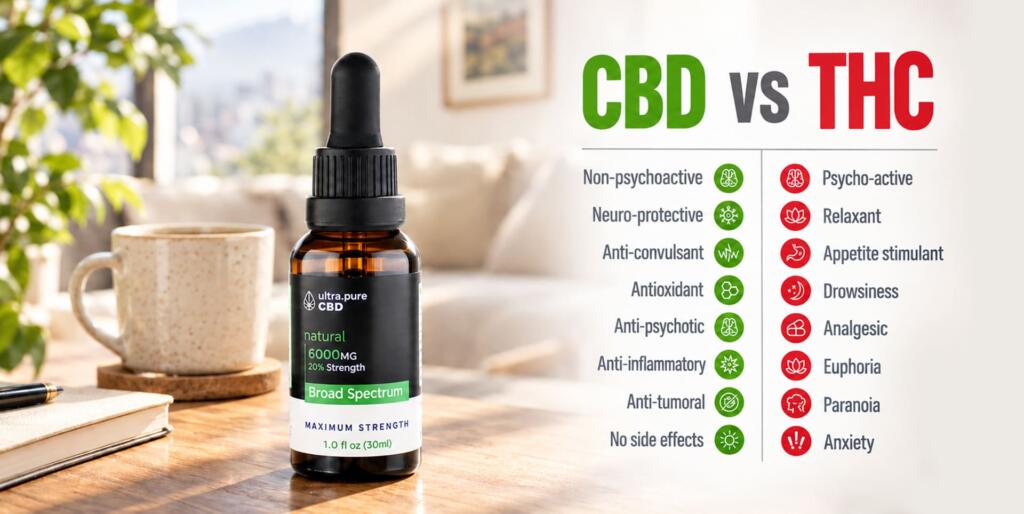
A lot of confusion about CBD and addiction comes from one source: CBD and THC are both compounds from the cannabis plant, but they interact with the brain very differently.
THC binds directly to CB1 receptors in the brain, producing the intoxicating “high” that drives compulsive use in some people. A 2014 review of cannabis use disorder outlined the recognised — if modest — dependence potential of THC-heavy cannabis: heavy users can experience irritability, insomnia, vivid dreams, and craving when they stop. The U.S. National Institute on Drug Abuse publishes a similar picture in its column.
CBD does not bind to CB1 receptors in the same way. In fact, CBD appears to act as a negative allosteric modulator at CB1 — meaning it can dampen the effect of THC when the two are taken together. This is why CBD-only products do not produce a high, do not produce withdrawal, and are not associated with the kind of compulsive use pattern seen with THC-heavy cannabis.
In simple terms, CBD is to THC roughly what a non-alcoholic beer is to whisky. They share an origin…they do not have the same properties.
Can you become dependent on CBD for sleep?
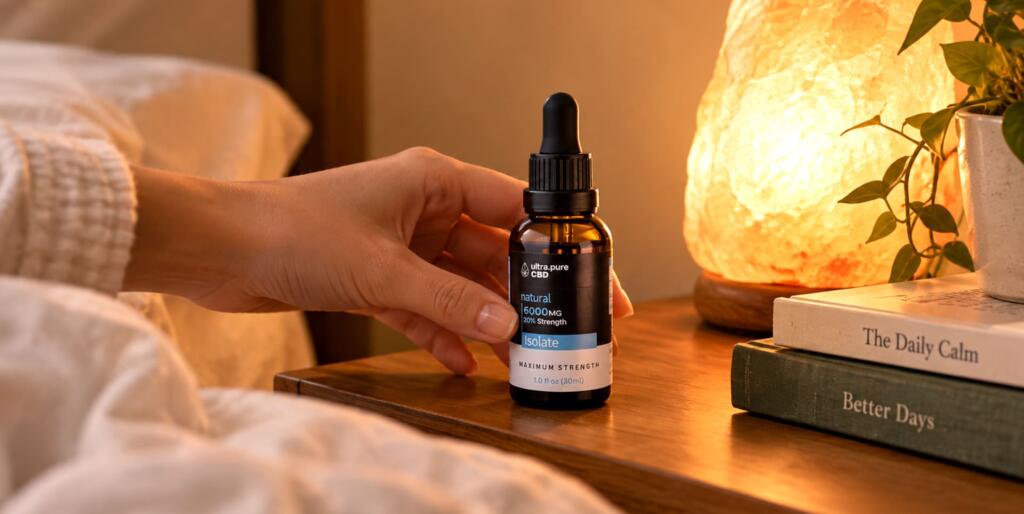
A customer asked this a few days back, “I sleep better with CBD; what if I stop? Will I crave for it every night?” Well, there is currently no evidence of a CBD withdrawal syndrome when regular use is stopped.
In a 2020 randomized trial, 30 healthy volunteers took 1,500 mg of purified CBD per day for four weeks, then they stopped it and, after two weeks, continued it.
Researchers then looked specifically at what happened when CBD was stopped. They found no evidence of a withdrawal syndrome.
That does not mean everyone will sleep exactly the same after stopping CBD. If you feel that CBD was helping your sleep, you may simply notice that difference when you stop using it. That is different from your body going through withdrawal.
What happens if you stop taking CBD?
For something people worry might be addictive, the obvious test is simple: what happens when you take it away?
With CBD, there is no physical withdrawal symptoms documented in research. You may still miss having CBD around. But again, that is a preference, not addiction. This is very opposite to THC.
If you still want to evaluate your relationship with your daily dose, try tapering off or taking a scheduled break. For instance, pausing CBD over a weekend or stepping down your dose over a few days. This way, you can figure out if it’s a routine craving or an addiction.
When CBD use could become a concern
There is another side to this conversation that has less to do with the CBD molecule itself and more to do with how you use it.
For example, someone might start taking CBD every time they feel anxious and gradually stop dealing with the reason they are anxious. The concern there is not that CBD has suddenly become an addictive substance. It is that the person may be relying on one routine instead of addressing an underlying problem.
Another issue is the dosage. While there is no universal dosage but there is a limit to everything. If someone is using CBD products excessively, the conversation is about behaviour management, not chemical dependence.
The same idea applies to vaping.
If someone vapes CBD repeatedly throughout the day, the habit of reaching for a vape can become deeply ingrained. But that does not mean CBD has the same addictive properties as nicotine. The behaviour and the substance are two separate things.
So if you feel that your CBD use is becoming difficult to control, keeps increasing, or is interfering with your daily life, it is worth talking to a healthcare professional.
Practical takeaways for everyday users
If you take CBD regularly, here is what the evidence supports:
- You do not need to escalate the CBD dose to get the same effect over time. Give yourself 5 to 7 days to adjust, then gradually increase the dose. Most users who find their effective dose remain stable.
- You can stop CBD without withdrawal. If you stop, the worst case is that the symptoms you were managing return — not new symptoms caused by the absence of CBD.
- You should still be thoughtful about daily use. A habit is not an addiction, but any daily supplement is worth checking in on — does it still serve a purpose? Is it doing what you hoped?
- CBD does not combine dangerously with most substances, but always check with your doctor if you take prescription medication
At I Love Joint, all CBD products are confirmed THC-free as they come with a COA. We also do testing in a DEA-registered lab and Georgian forensics lab. So, it’s 100% legal in Georgia. You can shop now on our website or visit our stores:
ILJ Store: Tbilisi
- Vake: 12–14 Napareuli St
Monday–Sunday: 12:00 PM–10:00 PM - Old Tbilisi: 17 Atoneli St
Monday–Thursday: 2:00 PM–11:00 PM
Friday–Sunday: 2:00 PM–2:00 AM - Liberty Square: 9 Shalva Dadiani St
Monday–Thursday: 11:00 AM–11:00 PM
Friday–Sunday: 11:00 AM–3:00 AM
ILJ Store: Batumi
- Amirejibi 1
Open daily: 12:00 PM–10:00 PM
Frequently Asked Questions (FAQs)
No. The WHO found no abuse or dependence potential in pure CBD in 2018.
Yes, you can. There is no documented withdrawal symptoms from CBD.
No. CBD is a compound from the hemp plant. It does not produce a high. It is not cannabis in the recreational or psychoactive sense.
CBD may improve your sleep quality while you use it. Stopping does not cause withdrawal, but some people find their sleep quality reduces temporarily.
Conclusion
So, is CBD addictive? No. The WHO’s position is clear, and the research backs it up too. CBD does not cause a high, craving, or withdrawal. This is what makes CBD very different from THC, which can cause dependence in some regular users.
That said, the product you buy still matters. Make sure the product has transparent ingredients with CBD concentration, is sourced legally, and has 0 THC trace.
In Georgia, I Love Joint is the trusted CBD retail chain. We sell COA (Certificate of Analysis) verified and legally imported CBD products in Georgia.
Looking for THC-free CBD in Georgia? Explore our premium CBD oils or visit our stores in Tbilisi and Batumi.