Introduction
Ever since CBD has started showing up on shelves, there has been increased interest in one question: Is CBD addictive? Because CBD derives from cannabis, people immediately think of it like THC: getting high, dopamine rush, dependency and so on.
But CBD and THC are completely different compounds, and the science on this is worth understanding before you form an opinion. This guide will help to understand that reality. Every claim we make is backed by WHO, clinical research, and actual evidence. So, let’s get started!
CBD is not physically addictive. The World Health Organization confirmed in 2017 that pure CBD shows no abuse or dependence potential. Clinical studies confirm that stopping CBD does not produce withdrawal symptoms.
Is CBD addictive?
So, can CBD get you addicted? The short answer, backed by one of the most respected health authorities on the planet, is no.
In 2017, the World Health Organisation published a comprehensive review of cannabidiol and its findings were unambiguous: CBD, in its pure form, exhibits no effects indicative of any abuse or dependence potential.
But first, what exactly does abuse & dependence mean?
Abuse potential refers to whether a substance produces a reward signal in the brain. Like a dopamine or adrenaline rush.
Dependence refers to whether your body adapts so strongly that removing it causes physical harm. For instance, nicotine or tobacco. Nicotine, alcohol, opioids, and THC can fit one or both of those patterns. CBD doesn’t.
Does CBD Cause Withdrawal Symptoms or Dependence?
You’ve probably heard how drugs & substances work. Quitting them abruptly may lead to sweating, shaking, and cravings. So it’s fair to wonder whether CBD works the same way.
To clarify, there can be no physical CBD withdrawal symptoms. A clinical study published in Epilepsy & Behavior verifies this claim.
The research — Notcutt et al., Epilepsy & Behavior, 2020
The authors: Lesley Taylor, Julie Crockett, Bola Tayo, Daniel Checketts & Kenneth Sommerville
The Study: Thirty healthy volunteers were given 750 mg of pharmaceutical-grade CBD twice daily for four weeks. That is way higher dose than most people ever take. After that, half of them stopped abruptly.
What they found: Participants who stopped CBD suddenly did not develop withdrawal symptoms. Withdrawal scores on both the Cannabis Withdrawal Scale and the Penn Physician Withdrawal Checklist remained close to zero throughout.
That said, it is worth drawing a line between physical and psychological CBD dependence. You will not experience physical withdrawal, but it is possible to become attached to a routine that includes CBD.
Just like getting dependent on coffee every morning, evening walks, a glass of wine after work, or any routine that makes you feel better. But all these are coping habits, not a pharmacological process. In the same way, CBD does not change the brain’s chemistry in an addictive way.
Yes, the initial discomfort is real. The only fix is to use CBD as a support. Don’t replace it with your other wellbeing practices.
What's the difference between CBD addiction and THC addiction?
Both CBD and THC is that both come from the same plant, cannabis. So, shouldn’t they carry the same risk of addiction? Well, not really.
The way THC affects the receptors of your brain is not the same way CBD and the brain interact. Here’s the difference between the two:
| Features | CBD | THC |
|---|---|---|
| Psychoactive effects | None | Produces a high |
| Dopamine reward activation | Does not trigger dopamine | Actively binds CB1 receptors of brain that produce intoxication |
| Abuse potential (WHO) | None identified | Recognized risk |
| Withdrawal symptoms | Not observed in studies | Can occur with regular use |
| DSM-5 disorder link | Not implicated | Linked to Cannabis Use Disorder |
| Legal in Georgia | Yes, when THC-free | Restricted |
How do you know your CBD is truly THC-free?
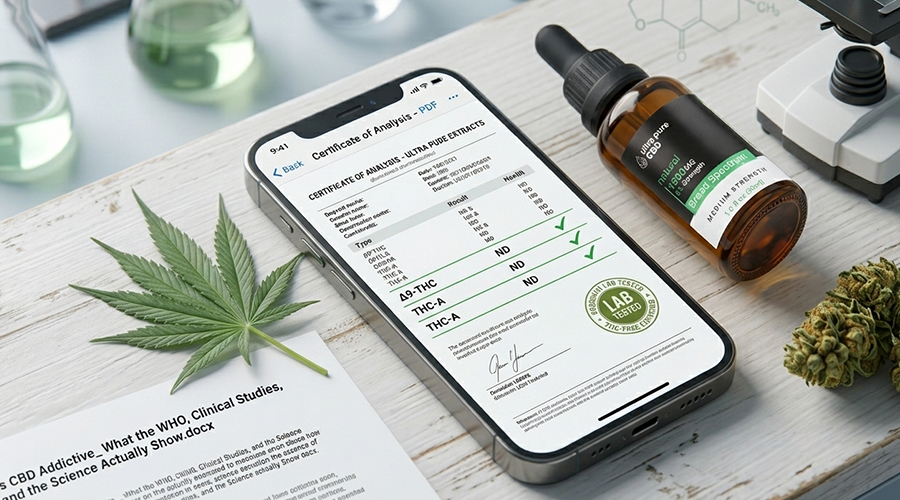
All the addiction risk associated with CBD products is almost entirely a question of product purity. If your CBD product contains THC, even in small amounts, then you are no longer dealing with pure CBD. And it is the THC in that mixture, not the CBD, that carries any dependence risk.
The safest CBD products come with a Certificate of Analysis (COA). is a third-party lab document that lists the cannabinoid profile of a CBD product, including whether THC is present and at what concentration. It also screens for contaminants. It is the proof behind the label.
For Georgia particularly, THC limit for hemp-dervied CBD is less than 0.3% on a dry-weight basis.
At I Love Joint, every product ships with a COA you can review yourself. Our products like Ultra Pure Extracts CBD Oil is broad-spectrum and 100% THC-free oil. What makes us stand out is that our products are also tested by independent Georgian lab.
Is hemp addictive? What about full-spectrum CBD?
Let’s clear up one more source of confusion. Hemp and marijuana are both cannabis plants, but they are not the same thing. And the biggest differentiator is their THC content.
Hemp naturally contains only trace amounts of THC (less than 0.3%) which makes hemp non addictive.
On the other hand, marijuana contains much higher levels that can produce a psychoactive “high. This is why most products sold in Geogia are are extracted from hemp rather than marijuana.
Where people often get confused is the type of CBD they’re buying.
- Full-spectrum CBD – it has all the naturally occurring compounds from the hemp plant, including trace amounts of THC up to the legal limit i.e. 0.3%
- Broad-spectrum CBD – Goes through an additional extraction process that removes all detectable THC while keeping the other beneficial hemp compounds.
- CBD isolate – this is pure CBD, with nothing else. No cannabinoids or terpenes.
If your goal is to avoid THC completely, broad-spectrum CBD or CBD isolate is the better choice. Although the trace THC found in legal full-spectrum products isn’t expected to produce psychoactive effects, some people prefer eliminating THC altogether for added peace of mind.
Can CBD help people recover from addiction?
Now that you know that CBD is not addictive, can it rather help people recover from addiction? So far, the findings are promising but still early. Here is what the science looks like right now:
- Anxiety & Sleep Disorders – A research study was done on 72 adult patients where they were tested monthly for anxiety & sleep quality. Of which, 80% of participants saw reduced anxiety levels during the first month of CBD use, while around two-thirds reported better sleep. This indicates that CBD helps with sleep and anxiety disorders.
- Alleviation of chronic pain – Human studies are increasingly substantiating that CBD helps control pain, including inflammatory and neuropathic pain, which are difficult to treat. This matters because chronic pain is a major relapse driver.
- Reduction in cravings – Many people get cravings from opioids and stimulants. CBD may help reduce cue-triggered cravings and anxiety in people recovering from opioid use disorder. But researchers agree that larger clinical trials are needed before CBD can be recommended as part of addiction treatment.
NOTE: The findings above are preliminary and not definitive conclusions. You cannot use CBD as a standalone treatment for addiction. If you live in Georgia and are considering CBD as part of your personal recovery journey, speak with a healthcare professional first.
The Bottom Line: Is CBD Addictive?
If you’ve made it this far, here’s the short version. Based on the WHO’s 2017 assessment and multiple clinical studies, pure CBD is not physically addictive. Moreover, stopping it doesn’t appear to cause withdrawal in most people. The dependence risk is usually tied to THC content in CBD products.
So, if you want to reap CBD benefits without any dependence concern, choose a product that is genuinely THC-free and backed by Certificate of Analysis (COA). That’s the safeguard.
I Love Joint’s Ultra Pure Extracts CBD Oil is broad-spectrum, 100% THC-free, and comes with a full Certificate of Analysis you can review before you buy.
Looking to buy certified CBD products in Georgia? Explore the range online or check out our full CBD shops in Tbilisi & Batumi.
Frequently Asked Questions (FAQs)
Well, pure CBD (cannabidiol) on its own is not addictive. Only when it is combined with high percentage of THC, it can cause high effects.
Discontinuing CDB will not cause any withdrawal symptoms. However, if you have been using CBD regularly to manage a condition like anxiety, insomnia, or any other condition, you can see the symptoms surface back again.
Physically, CBD oil does not create any dependence. That said, your mind can grow accustomed to the relief CBD provides. That is more of a psychological reliance.
CBD in low to moderate dosage, taken every day, is good. However, everyone’s is different. So, you must consult with a healthcare professional before committing to a long-term CBD regimen.
Pure CBD does not trigger standard drug tests. However, some CBD products contain trace amounts of THC, which may lead to a positive result. While ILJ’s CBD products are THC-free, no company can guarantee a negative drug test under every circumstance.