Introduction
Periods, PCOS, perimenopause, menopause, poor sleep, stress – women deal with all of this. To cope with all of this, they have been searching for CBD for women in growing numbers.
But with so many conflicting claims floating around online, it’s hard to know what’s promising and what’s a marketing gimmick.
If you are someone who’s wondering whether CBD is worth trying, this guide is for you. We will break down what research says about CBD and menstrual pain, menopause, anxiety, sleep, and hormonal health.
Many women use CBD for stress, sleep, menstrual discomfort, and menopause symptoms. Research is still early-stage, but the existing evidence on CBD’s interaction with the endocannabinoid system is encouraging. CBD is not recommended during pregnancy or breastfeeding. If you’re on hormonal medication, check with your doctor before starting CBD.
Why is CBD used more by women than men?
Women make up a larger share of CBD users in wellness contexts. They have been in fact pushing the CBD market upwards compared to men. Brightfield Group data shows that women made up 58% of people using CBD-dominant cannabis products.
In another study from the Journal of Cannabis and Cannabinoid Research of 2409 respondents, researchers found that women use CBD to treat a medical condition. Men, on the other hand, mostly use CBD for general health and fitness
This difference may partly reflect women’s stronger interest in the wellness and therapeutic side of cannabis rather than its intoxicating effects.
Another reason for growing interest in CBD can also extend into areas that are specific to different stages of life, including menstrual discomfort and menopause-related concerns. These areas have helped push CBD into the wider women’s wellness conversations. Now let’s discuss them in detail.
CBD and menstrual pain
Laboratory studies show CBD has anti-inflammatory and pain-modulating effects, and researchers have identified cannabinoid receptors in uterine tissue, which helps explain how cannabinoids may influence cramps at the source.
Clinical trials are still catching up, but surveys tell an encouraging story. Research suggests that CBD may support broader relief from inflammation and pain that make ordinary periods miserable, and for many women that alone is worth it.
Research Spotlight: McMahon et al. (2024)
- Who: 33 women took part in a three-month study of oral CBD for menstrual-related symptoms.
- The Study: Participants took either 160 mg or 320 mg of CBD twice a day for five days each month, starting when their menstrual symptoms began.
- Key Findings: Both groups reported reductions in overall menstrual symptoms, irritability, anxiety, stress and perceived symptom severity compared with their baseline.
- Source: PubMed — McMahon et al., 2024
CBD and menopause
Menopause has a funny way of turning ordinary things into problems you never asked for. Our fellow ladies reading this can vouch for it. Hot flashes, mood swings, irritability, anxiety, knee pain, sleep disturbance…and the list goes on.
While hormone replacement therapy remains a standard treatment, many women are exploring an alternative approach with CBD. But is CBD good for menopause? Well, direct research is young, but the indirect evidence is strong:
In the NIH 2023 survey, 750 women aged 35 and over were asked for their results on CBD for menopause. 57% of midlife women who used cannabis products for menopause symptoms a clear majority reported relief, and many rated it comparable to or better than their usual painkillers.
Another survey published in The Journal of Menopause Society talks about CBD’s usage in premenopause and post menopause. 78.7% of women used CBD for menopause-related symptoms. Sleep disturbance topped the list of symptoms, with mood swings and anxiety taking runner-up spots.
There is biology in this too. The endocannabinoid system declines with age, and some researchers link that drop to the mood and sleep changes of menopause. Supporting it with a daily broad spectrum CBD oil is a low-risk experiment. In fact, many women have seen positive improvements in their sleep quality and stress responses with consistent usage.
Note: No CBD product is licensed to treat menopause. You can add it to your wellness routine as a supplement. It is not a cure.
CBD for women anxiety and stress
If one area of CBD research has moved past speculation, it is anxiety. That matters for women, who are nearly twice as likely as men to experience anxiety disorders and who often carry a low-grade hum of stress that never switches off: work, family, hormones, repeat.
Now, the research is still developing, but there are some interesting human studies.
Research Spotlight: Nayak et al. (2024)
- Who: Manan M. Nayak, Peter M, Paul J.C, et al
- The Study: A study evaluating the effect of a 400 mg dose of CBD versus placebo on anxiety.
- Key Findings: The 400 mg CBD dose did not beat the placebo on the study’s main anxiety measure, but women receiving CBD reported lower anxiety scores between two and four hours post-dose.
- Source: Cannabidiol for Scan-Related Anxiety in Women With Advanced Breast Cancer
CBD and sleep
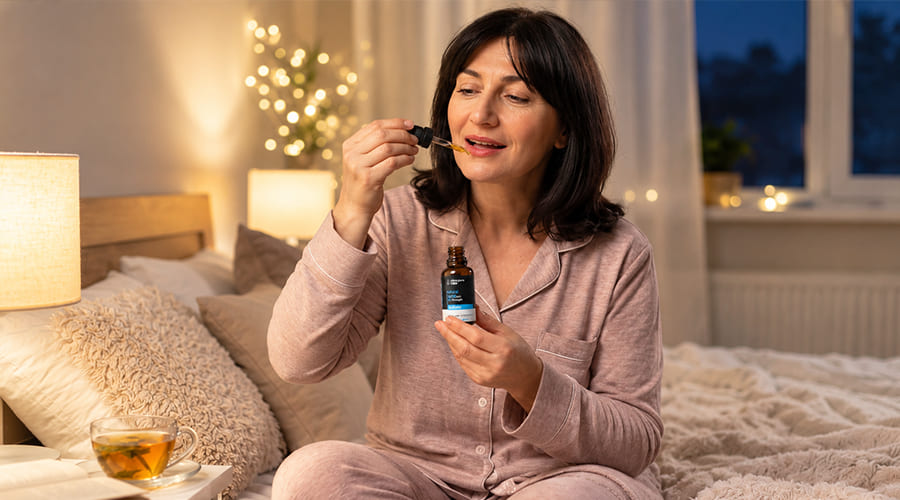
Sleep disruption is common in women across reproductive life stages. Be it period cramps, anxiety, everyday stress, or nursing a baby during pregnancy – all of it hits right when it’s bedtime. And during perimenopause and menopause, it can be even more frustrating. You fall asleep, wake up hot, fall asleep again, then wake up for no obvious reason.
So where does CBD fit in?
Well, CBD is not a sleeping pill, so it won’t sedate you. But it may, however, influence systems involved in sleep, stress, and the body’s response to discomfort. Here’s what research says:
Research Spotlight: Wang et al. (2025)
- Who: Wang M, Faust M, Abbott S, et al
- The Study: A randomized controlled pilot trial involving 30 adults with moderate to severe insomnia. 15 participants received 150 mg of CBD nightly, while 15 received a placebo.
- Key Findings: Participants taking a THC-free formulation containing 300 mg of CBD plus several terpenes showed an increase in the amount of deep-wave and REM sleep compared with placebo. The CBD group also reported higher well-being.
- Source: PubMed Clinical Trials – Evaluation of CBD-Terpene Formulation on Sleep Physiology
Other research suggests the effect of CBD is dose-dependent: lower doses support daytime balance, while higher, consistent evening doses are more likely to promote rest.
This matters for women, because female insomnia is rarely just insomnia. The root cause matters more. Therefore, working on the cause rather than the symptom is what makes CBD a reasonable sleep tool instead of another pill that stops working within weeks.
Is CBD safe during pregnancy or breastfeeding?
So far, we discussed how CBD may support your sleep, anxiety, stress, or period pain. But here, we will be direct: CBD is not recommended during pregnancy or while breastfeeding.
Major health institutes like the FDA, WHO, and independent researchers also advise on avoiding CBD during breastfeeding & pregnancy. And there are solid reasons backing this claim.
Firstly, there is not enough research to confirm it is safe for a developing baby. CBD can cross the placenta, and it can negatively impact fetal reproductive development, cause inflammation, and increase respiratory vulnerability.
The same applies to lactation: CBD can enter the bloodstream, and no one knows if it is safe for infants. Their neurological systems are still developing, and exposing a nursing baby to CBD through breast milk is an unnecessary risk when there is no proven benefit to justify it.
Lastly, CBD products are poorly regulated in Georgia. And a lot of brands leverage this to sell contaminated CBD products with THC, pesticides, bacteria, or fungi that harm a baby.
CBD and hormonal medications — what to know
Is CBD safe for women with hormonal conditions? For most, yes.
The WHO has stated that CBD is generally well-tolerated with a good safety profile. The adverse effects are usually because of drug interactions between CBD and the patient’s current medications.
This matters because CBD is metabolised in the liver by the CYP450 enzyme family – the same system that metabolises many common medications that women take for hormonal and metabolic health. These include:
- Birth control contraceptives (oral pills, patches, rings)
- Hormone replacement therapy (HRT) – used in perimenopause and menopause
- Thyroid medication such as levothyroxine
- Anti-seizure medications like clobazam and valproate
- Blood thinners like warfarin
So, if you are taking any of the above, the advice is simple: talk to your GP or prescribing doctor before starting CBD.
You don’t need to stop your medication, and you don’t need to give up on CBD — but this is to avoid any side effects you may face. A 5-minute conversation with your doctor can save you from an avoidable interaction.
How to use CBD oil?
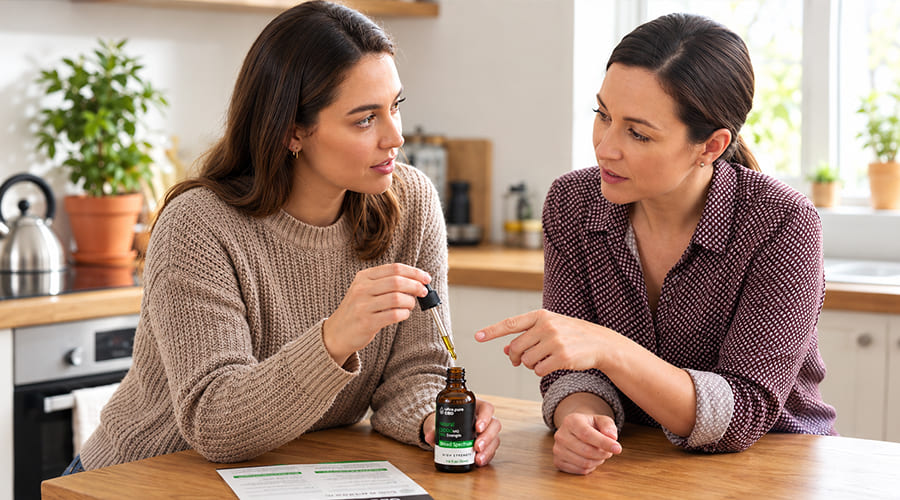
If you have decided to try CBD, start with a beginner-friendly option like CBD oil. The sublingual (under-the-tongue) method is the most common and cost-effective way to use it:
- Shake the bottle gently before each use to mix the contents.
- Place the recommended number of drops under your tongue using the dropper.
- Hold for 60 seconds. This allows CBD to absorb through the mucous membranes directly into your bloodstream, bypassing the digestive system.
- Finally, swallow whatever remains.
A typical starting dose is 5 to 10mg once daily. Stay at this dose for a week, then adjust up or down based on how you feel. Want more clarity on dosage? Check out our detailed CBD dosage guide.
Important Note: CBD is biphasic in some effects (meaning a small dose may be calming while a larger dose may be stimulating). Hence, more is not always better.
Frequently Asked Questions (FAQs)
CBD is generally well-tolerated by women. They can take CBD to relieve stress, anxiety, sleeplessness, and as part of their wellness routine. However, CBD is not recommended during pregnancy or breastfeeding.
Some women report reduced discomfort during their period when using CBD oil, and pre-clinical research supports the plausibility of an anti-inflammatory effect. However, no CBD product has been clinically proven to treat menstrual pain, and high-quality human trials are still limited.
Not directly, but CBD may interact with the endocannabinoid system, which plays a role in hormonal regulation. The effects can vary. So, if you’re taking hormonal medication, check with your doctor before using CBD.
Yes. CBD products derived from hemp with 0% trace of THC are 100% legal to purchase and possess in Georgia. If you want more in-depth details, then check out our guide on “Is CBD Legal in Georgia”
We would recommend that you start with CBD oil. It is low risk, the dosage can be adjusted, and you don’t have to digest or inhale it. Our Ultra Pure Extracts broad-spectrum CBD oil at 5% concentrate fits this profile.
Final Thoughts
That said, CBD for women is not here to be a cure for menopause, endometriosis, PCOS, or anxiety.
What CBD can be is one tool in a wider wellness toolkit: a non-intoxicating, generally well-tolerated option that some women find helpful for stress, sleep, menstrual discomfort, and the daily friction of hormonal life.
If you’re curious, start low, be consistent, and pay attention to how you actually feel. And if you are buying CBD in Georgia, make sure to look for a product that is THC-free and comes with a third-party Certificate of Analysis.
At ILJ, we stock US-imported and 100% THC-free CBD products. From gummies & oil to vapes and e-cigarette liquids, we have everything. If you have any questions, our team is available in-store to answer your questions, help you choose a starting strength, and talk through any concerns.
So, what’s the wait for? Find our nearest CBD store locations here.