Introduction
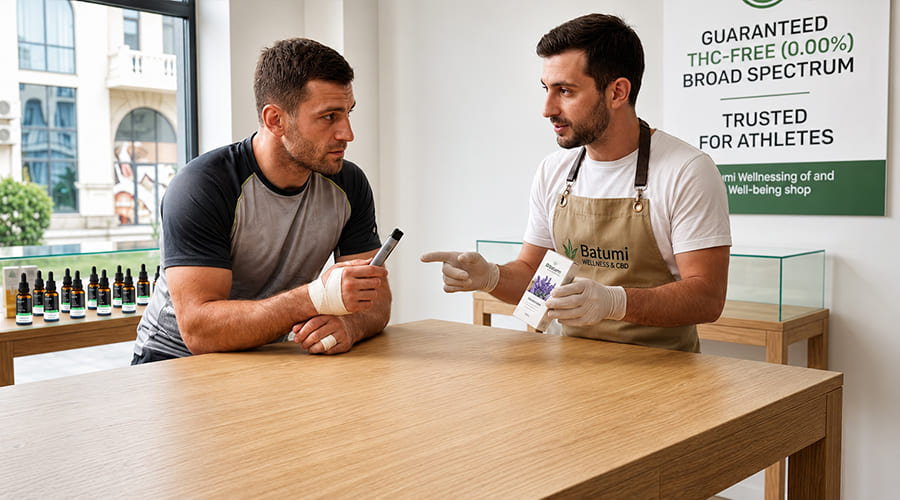
Lately, CBD for athletes has caught the attention of sportspeople. A rugby player came into our Batumi store last month. He asked, “I need something that helps me recover and won’t screw up my drug test. Can you guarantee this is clean?”
Honestly, we get it. CBD is technically unregulated in Georgia. Anyone can sell anything and call it CBD. For a competitive athlete, taking THC-contaminated CBD can lead to health risks, suspension, and sometimes a permanent ban from the sport. That is not a risk worth taking on a guess.
But athletes don’t look at CBD just for muscle soreness. Many intend to use it to recover from post-workout inflammation, improve their sleep, reduce training stress, and ease pre-match anxiety.
So is CBD safe for athletes and can it be used by them? If yes, how does it help athletes recover? And what does the research say about this? This guide has all the answers. Before you buy your next CBD product, get all your doubts about CBD cleared here.
CBD is not banned in sport. WADA removed it from the prohibited list in 2018. However, THC remains banned in Georgia, so athletes should use only THC-free (broad spectrum) products. Research shows CBD may help with sleep, post-training inflammation, and managing training-related anxiety. The evidence is promising, but it is not a performance enhancer.
Is CBD banned in sport?
No, pure cannabidiol (CBD) is not banned in sport. The World Anti-Doping Agency (WADA) permits the use of CBD in Georgia. The problem starts when the product contains something that is prohibited.
THC and synthetic cannabinoids can create a problem for competitive athletes. Because they are still banned in Georgia. Yet, a lot of shops sell over-the-counter CBD oils and products that have undisclosed traces of THC or additives.
All this can trigger a positive test. If a prohibited substance shows up in your sample, you are responsible for it, even if you didn’t know it was in the product. Because the CBD market in Georgia is unregulated, there is no authority checking what is actually inside the bottle.
Which is why, as an athlete, you must opt for:
- CBD products with zero THC content
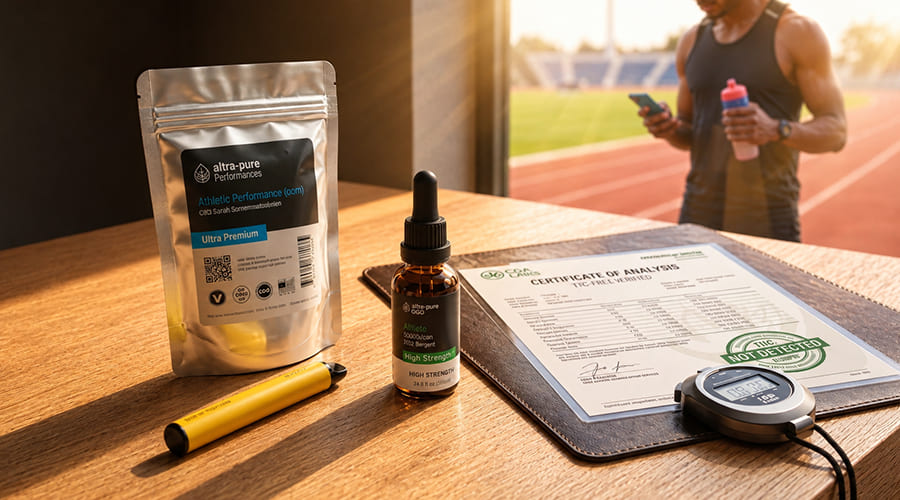
- A recent COA (Certificate of Analysis) showing what is actually in the product
- A reputable manufacturer with transparent sourcing
That is exactly what we do at I Love Joint. Every product we sell is officially imported, lab-tested (COA on file), and verified THC-free.
Now let’s move on to the use cases of CBD for athletes.
CBD and post-training inflammation
Inflammation after exercise is not automatically a bad thing. Your body needs an inflammatory response to repair tissue and adapt to training. But when inflammation becomes excessive, recovery slows, and injury risk goes up.
CBD has attracted interest because laboratory and early human research suggests it may influence pathways involved in inflammation and oxidative stress.
But how does CBD achieve that? A 2023 review published in PMC looked at how CBD affects athletes specifically. The review found that CBD interacts with the endocannabinoid system to control inflammation and modulate pain perception.
Modern research also provides some encouraging findings. A human pilot study found that a single dose of CBD lowered IL-6 readings after eccentric exercise in the CBD groups. But the researchers also noted that the study was too small to treat the results as firm findings.
So, yes, CBD may support recovery from exercise-related discomfort and inflammation, but the current human evidence is too limited to consider it a cure.
CBD and sleep — the biggest recovery tool
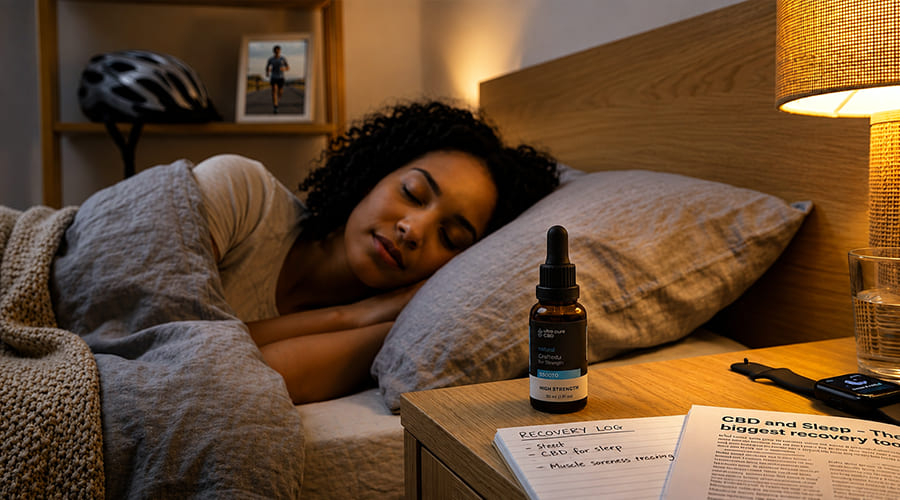
Ask any sports scientist what the single most important recovery tool is, and sleep will top every list.
It is during deep sleep that growth hormone is released, muscle tissue is repaired, and the nervous system resets. But when sleep suffers, everything from energy and mood to training consistency can become harder to manage.
The 2019 Permanente Journal study found that 66.7% of participants reported improved sleep scores within the first month of CBD use. While the study wasn’t conducted specifically on athletes, the findings still matter for recovery. For athletes who train twice daily or consecutively, sleep quality becomes even more critical.
Since THC-free CBD is safe and legal, it can be taken around 30-60 minutes before sleep. This is the most common approach, although timing and effects can vary from person to person.
CBD and muscle soreness
Delayed onset muscle soreness (DOMS) is the familiar stiffness and tenderness that kicks in 24 to 72 hours after a hard session. This is common among athletes and sports people, especially when they go through resistance training.
CBD is sometimes used after training because of its potential effects on pain and inflammation. Infact a lot of athletes who buy from us come back showing a positive response.
That said, it is important to frame this correctly. CBD is not a substitute for the fundamentals: adequate protein intake, proper hydration, sufficient rest, and a well-structured training program.
The evidence here is largely anecdotal at this stage, but it is one of the most common reasons athletes give for trying CBD.
CBD and training anxiety
Athletes deal with a particular kind of stress.
There is pressure before competition, nerves before a major event, frustration after a bad match, and the general mental load that comes with pushing your body repeatedly. For athletes looking for ways to manage that mental pressure, CBD for stress can be worth exploring.
A 2024 study found that participants who believed they had taken CBD during stressful times showed lower cortisol levels. Another PMC study concluded that CBD interacts with serotonin (5-HT1A) receptors in the brain to naturally down-regulate panic and performance anxiety.
All these can be connected to sports, where athletes go through training anxiety and stress. In such situations, CBD may support a sense of general calm.
How to use CBD as an athlete?
If you are new to CBD, a practical approach is to start with a low amount according to the product’s instructions and see how your body responds.
For general routine planning, athletes commonly consider CBD at different times depending on their goal:
- After training: 15–25mg of sublingual CBD oil within 30 minutes of finishing your session. This aligns with the window when inflammation is beginning to ramp up.
- Before sleep: Some users take CBD oil 30 to 60 minutes before bed as part of their nighttime routine.
- Before competition: This requires more caution. Check your sport’s anti-doping rules, review the exact product ingredients and testing documentation, and discuss its use with your coach, sports doctor, or qualified professional.
Also choose the right format.
Sublingual oil is the most common choice for athletes because you can adjust the dosage, and its effects tend to last longer. This can be useful for post-training recovery and overnight sleep support.
For quick results and that pre-match anxiety, vapes can be a good option. However, don’t overdo them. And finally, CBD gummies and capsules work best when taken at least 30-45 minutes before downtime.
If you are looking for CBD in Georgia, visit our website, I Love Joint. You can browse and order our full range of CBD products.
Prefer to shop in person? Visit us at one of our locations:
- Tbilisi – Vake: 12 Napareuli St (Mon–Fri: 12:00 PM to 10:00 PM)
- Tbilisi – Old Tbilisi: 17 Atoneli St (Mon–Thu: 2:00 PM to 11:00 PM | Fri–Sun: 2:00 PM to 2:00 AM)
- Tbilisi – Liberty Square: 9 Shalva Dadiani St (Mon–Thu: 11:00 AM to 11:00 PM | Fri–Sun: 11:00 AM to 3:00 AM)
- Batumi: Amirejibi 1 (Open daily, 12:00 PM to 10:00 PM)
Full addresses and opening hours are available on our store locations page.
CBD vs ibuprofen for recovery
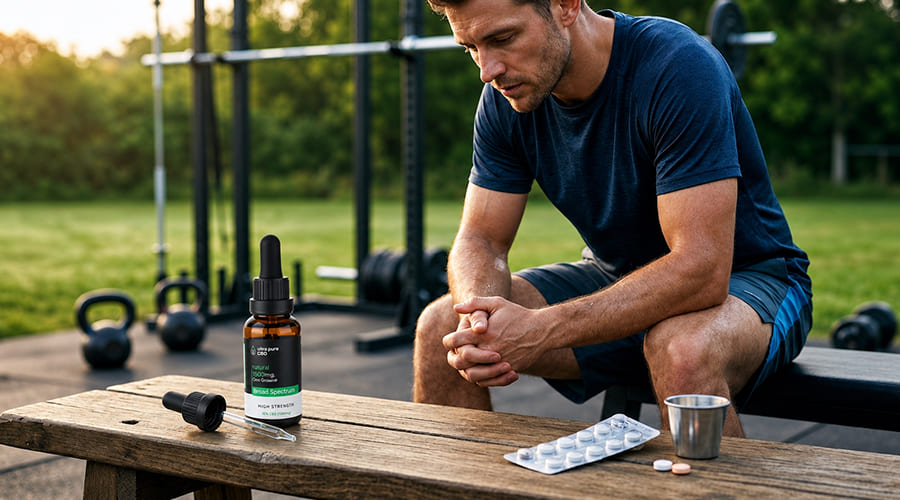
CBD and ibuprofen are not interchangeable.
Ibuprofen is an NSAID with established effects on pain and inflammation. It can be useful for certain short-term situations, like getting a little pain mid-match in your ankle. The problem is the long-term pattern. Many athletes reach for ibuprofen daily after training, and that cumulative use carries real risks – including gastrointestinal and kidney-related problems.
On the other hand, CBD is not a fast-acting sedative. It’s slower and does not work like an ibuprofen tablet. What some athletes report is a more gradual sense that recovery feels smoother, sleep comes easier, and the inflammation-related discomfort is less intense over time.
And unlike ibuprofen, there are no major risks at standard doses.
When choosing between CBD vs ibuprofen, it’s not about “Which one is stronger?” The better question is: “What problem am I actually trying to solve?”
Many athletes use both situationally. For daily use, people pair CBD with rest, nutrition, and hydration as a recovery support tool. Ibuprofen is best reserved for acute injuries or post-event situations
NOTE: CBD is not a replacement for medical treatment of sports injuries. If you have a real injury, seek a medical professional.
Frequently Asked Questions (FAQs)
No. WADA removed CBD from the banned substances list in 2018. However, THC remains banned. Athletes should only use THC-free, broad-spectrum products that come with a verified Certificate of Analysis.
While there is no evidence that CBD improves performance levels, it has shown a positive response for pain recovery and sleep quality, which indirectly affects performance over time.
Look for a reputable product with transparent sourcing, a recent COA certificate, and no trace of THC.
The two most common windows are within 30 minutes post-training and 30 to 60 minutes before sleep.
Yes, since CBD falls outside the purview of narcotics law in Georgia, it is 100% legal. The only condition is that the CBD product must be THC-free.
Final Thoughts
CBD is a legal, THC-free supplement with a realistic and growing evidence base for recovery and sleep. It suits athletes who want a non-pharmaceutical option with a low side-effect profile, particularly those who want an alternative to daily NSAID use.
The critical thing for athletes in Georgia is product selection. Because the market is unregulated, the only way to use CBD safely is to choose products that are verified THC-free, officially imported, and backed by lab testing. That is the standard we hold ourselves to at I Love Joint.
If you want to explore CBD for recovery, start with our Ultra Pure Extract Broad-Spectrum oil, take it consistently for at least two weeks, and pay attention to how your body responds.
Still have doubts? Visit the I Love Joint FAQ page and get all your answers.