Introduction
A guy came into our Vake store last month, bought a box of CBD pre-rolls, and said something that stuck: “I don’t want to quit smoking. I just want to smoke less and make a better choice.”
If you are searching for CBD to quit smoking, you are in the same boat. Speaking of Georgia, roughly one in three adults smoke daily. It’s almost a social culture. Walk down any street in Tbilisi, and you will see it outside every office, café, and bar.
Now that is where CBD can help with your smoking addiction. But what does the research actually say? And can CBD help you quit smoking for real? Let’s find out.
Can CBD help you quit smoking? A few early research suggests CBD may help reduce cigarette consumption and the urge to smoke again sooner. However, that doesn’t mean that CBD is a licensed smoking cessation treatment alone. You can use it as a complementary supplement alongside established methods.
Why do people smoke — and why quitting is hard?
In Georgia, offering a cigarette is practically a greeting here — hospitality, camaraderie, a reason to step outside. One in every four adults smoke daily, and despite stricter laws, the numbers keep climbing.
So, quitting remains an uphill battle. But the desire to quit is just as common.
To understand why quitting tobacco is hard, you must look at these two components of tobacco dependence: physical addiction and behavioral habits.
- The Physical Component: The Nicotine Trap
The addiction comes from nicotine – a chemical with a half-life of about one to two hours. As it clears from your blood, your body starts pulling you toward the next cigarette. That’s because the brain enters acute withdrawal. This triggers irritability, anxiety, and intense cravings.
- The Behavioral Component: Habits, Rituals, and Social Cues
Even if you can get past the worst nicotine withdrawal, you will still miss the act of smoking. That’s what we call behavioural dependence.
When a social situation or a moment of stress arises, people reach for their cigarette. And no, it’s not just because of cravings. It’s because of the pharmacological mechanism of nicotine that makes the person addicted.
Because these behavioral cues are deeply tied to emotional states and daily routines, they persist long after the physical need for nicotine is gone. This is exactly why most relapses happen weeks or months after quitting to smoke.
For these reasons, people are gravitating towards CBD as a smoking substitute. But before we get into the details of how CBD helps, let’s understand if there is any science-backed evidence to support this claim.
What does the research show on CBD and smoking?
Here’s the thing. There isn’t a massive body of research on CBD and smoking. But the studies that do exist are worth paying attention to — especially because no one in Georgia is writing about this.
Study 1: The 2013 UCL Smoking Reduction Trial
Who: Morgan et al., University College London. Published in Addictive Behaviors, 2013.
The Study: The researchers ran a small, double-blind, placebo-controlled pilot study on 24 tobacco-dependent smokers. Half got a CBD inhaler, half got an identical one with no CBD. They were instructed to use it whenever they felt the urge to smoke for one week.
What They Found:
- The CBD group reduced cigarette consumption by approximately 40%.
- The placebo group showed no meaningful change.
- Craving levels did not increase in the CBD group
Why does it matter: This is one of the most relevant studies for the idea of using CBD as a smoking substitute because participants used it when the urge to smoke appeared.
However, 24 participants is a small sample.
Source: “Cannabidiol reduces cigarette consumption in tobacco smokers: preliminary findings” — PubMed
Study 2 — Hindocha et al., 2018 — CBD And Cigarette Cues
Who: Chandni Hindocha, Tom Freeman, Celia Morgan and colleagues at University College London and collaborating institutions.
The study: Research involved 30 dependent cigarette smokers. Participants received either oral CBD or a placebo after overnight cigarette abstinence.
Researchers then tested how participants responded to pictures associated with smoking, such as cigarettes and other tobacco-related cues.
What They Found:
- CBD reduced the behavioural pull for cigarettes and tobacco.
- The CBD group rated cigarette images as less salient and less pleasant.
- The placebo group showed no change.
Why this matters:
Cigarette imagery (ads, other people smoking, an ashtray) is a major relapse trigger. Those triggers are a reason why smokers get pulled back to tobacco. This study shows that CBD may reduce how strongly those smoking-related cues grab your attention.
Source: Hindocha et al., “Cannabidiol reverses attentional bias to cigarette cues…” — Wiley Online Library
Study 3 — The 2023 Washington State University lab study (Lazarus et al.)
Who: Shamema Nasrin, Philip Lazarus and researchers from Washington State University and collaborating institutions.
The Study: This study is different from the above two studies. The researchers were not giving CBD to smokers and doing research. Instead, they did a lab study using human liver tissue and cell lines to examine CBD and its major metabolite, 7-OH-CBD.
What they found:
- CBD inhibited CYP2A6 — the liver enzyme that metabolises more than 70% of nicotine in the body — by 50% at low CBD concentrations.
- CBD reported slower nicotine breakdown. This means nicotine from one cigarette stays in the bloodstream longer, reducing the urgency to light the next one.
Why It Matters: This is the freshest study and the strongest mechanistic evidence. It explains why CBD might work on a biochemical level — not just behavioural.
Source: Nasrin, Lazarus et al., “Inhibition of Nicotine Metabolism by Cannabidiol…” — ACS Publications
How CBD may support quitting — three mechanisms
Taken together, these studies point to three areas worth watching.
- Slowing nicotine metabolism
If CBD inhibits CYP2A6 as the lab study suggests, nicotine from each cigarette may last longer in your system. So, you will have less urgency to smoke. - Dulling craving triggers
As per the Hindocha study, CBD may reduce the salience and pleasantness of cigarette cues — images, smells, social situations. And as per the 2013 study, participants of CBD saw reduced cigarette consumption too. - Supporting stress management
Ask anyone why they smoke and “stress” comes up fast. CBD has been studied for its potential to help with stress. In fact, we’ve had customers tell us our CBD vapes help during moments of acute anxiety. So, yes CBD does help with quitting smoking.
CBD And The Habit Of Smoking: The behavioural substitution angle and why it matters?
Beyond pharmacology, a large part of tobacco dependence is the ritual. People still crave to have a:
- hand-to-mouth movement
- Inhalation
- familiar routine of reaching for something when stressed
- social aspect of stepping outside with other smokers
This is something patches and gummies don’t touch. CBD here has the real advantage with behavioural substitution.
A CBD pre-roll can replicate more of the familiar smoking routine. The hand-to-mouth motion of a cigarette. You light it. You draw on it. You exhale. In the same way, CBD vapes can provide the hand-to-mouth and inhalation aspect without using tobacco. The format is identical and that matters more than people think.
If you are specifically looking for a smoking-format alternative, come shop at I Love Joint.
All our products are 100% THC-free, COA-verified, and legally imported. We have:
- Pre-roll Joints with OG Kush terpenes for people who want to replace a cigarette with something they can light and smoke.
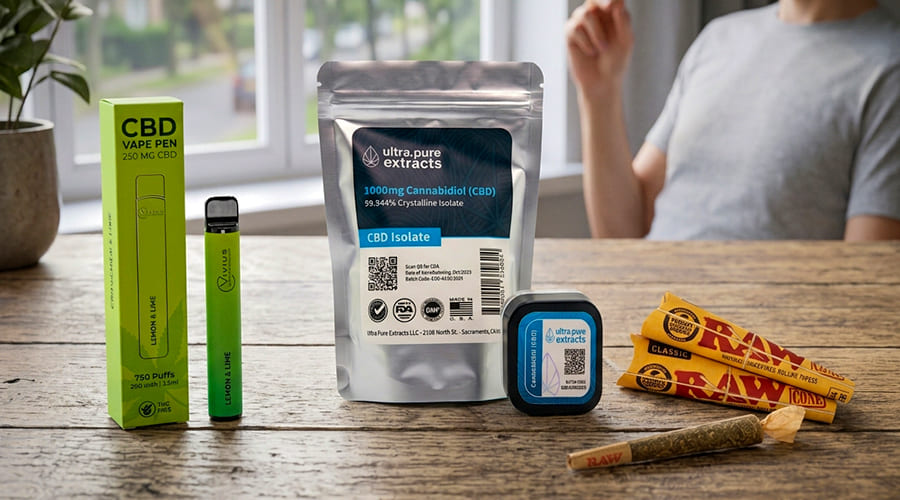
- Vivius CBD disposable vapes, available in 250 mg and 750-puff formats, for people who want the inhalation and hand-to-mouth routine without lighting a pre-roll.
- Vivius CBD vape cartridges with a CCELL USB-C battery for people who prefer a cartridge setup.
- Ultra Pure Extracts CBD oil for people who want to use CBD without smoking or vaping at all.
P.S. You can browse the available options through our CBD shop.
Is CBD addictive — will you just swap one habit for another?
The short answer is no.
The WHO 2017-18 expert committee report clearly states that THC-free cannabidiol has no dependence symptoms and abuse potential. This means it does not produce euphoria, nor does it have withdrawal symptoms. So, you can use CBD daily and stop it anytime. You won’t face any withdrawal symptoms.
On the other hand, if you smoke a tobacco joint, your body starts registering its absence within hours of cessation. That is what makes cigarettes so hard to walk away from. CBD has no equivalent pattern.
However, let’s also not confuse physical and psychological CBD dependence. Yes, you will not feel any urge to smoke physically, but there are chances you may get attached to a routine that includes CBD. But again, a routine is a habit, not a dependence — and habits are much easier to change.
For more in-depth evidence, you can check out our article: Is CBD Addictive?
How does CBD Compare with Established Methods to Quit Nicotine?
Here’s a comparison of CBD vs other methods:
- Nicotine replacement therapy (NRT) – It includes patches, gum, and mouth sprays. It is a well-established approach to managing nicotine dependence.
- Counselling and behavioural support — addresses the psychological side. The triggers, the patterns, the emotional reasons people smoke. This is scientific and has high chances for successful quitting.
- CBD – CBD is not a replacement for proven cessation methods. It’s a complementary option, particularly if the smoking ritual or environmental cues are a major part of their difficulty. It also eases the anxiety and stress that drives smoking.
So, if you’re experimenting with CBD as part of a reduction plan, the more sensible approach is to think about replacement rather than addition.
How to use CBD if you're trying to cut down on smoking?
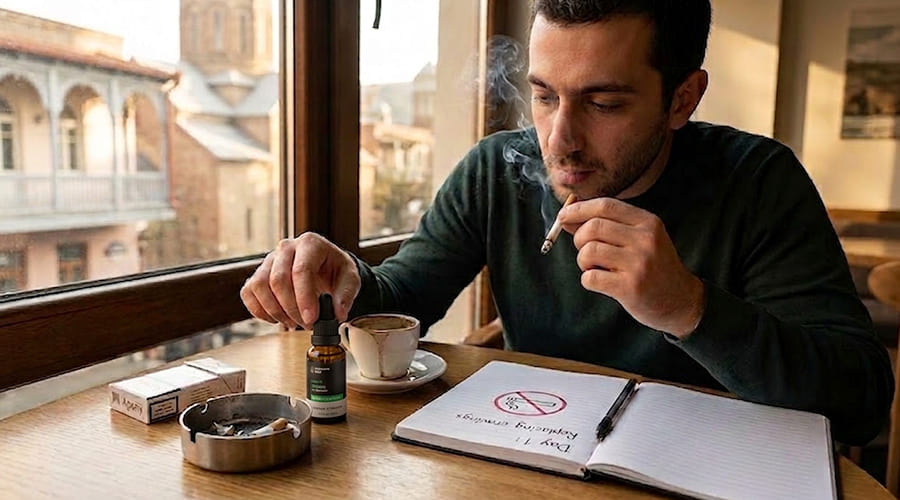
For someone in Georgia trying to smoke less, CBD may be worth considering as one tool in a broader quitting plan.
Below are some tips that can help you cut down on smoking:
- Go for on-demand use – Whenever you hit a craving, reach for a CBD product instead of a cigarette.
- Find your triggers – When do you feel the urge to smoke? Is it coffee, alcohol, work breaks, driving, socialising, or stress?
- Keep a count – If you are a stubborn addict, quitting initially would be difficult. So, to know your progress, keep track of how many cigarettes you actually smoke each day.
- Choose a format that matches your goal – If what you miss most is the hand-to-mouth action and the few minutes of stepping away, use a CBD pre-roll or disposable vape.
- Don’t chase a specific CBD dose – No clinically established CBD dosage works the same for all. You need to adjust it as per your body’s needs. For more details, check out our CBD dosage Guide.
- Use other support tools – CBD alone won’t help. If you’re serious about quitting, Georgia also has a national tobacco quitline at 116001. You can take up behavioural support and other evidence-based psychological treatments too.
Want To Buy THC-free CBD in Georgia?

I Love Joint is the trusted CBD store selling THC-free, COA-certified CBD in Georgia. You can buy here:
Tbilisi
- Vake: 12–14 Napareuli St
Monday–Sunday: 12:00 PM–10:00 PM - Old Tbilisi: 17 Atoneli St
Monday–Thursday: 2:00 PM–11:00 PM
Friday–Sunday: 2:00 PM–2:00 AM - Liberty Square: 9 Shalva Dadiani St
Monday–Thursday: 11:00 AM–11:00 PM
Friday–Sunday: 11:00 AM–3:00 AM
Batumi
- Amirejibi 1
Open daily: 12:00 PM–10:00 PM
P.S. If you can’t visit the store, order online at ilovejoint.ge/shop or get delivery in Tbilisi through Wolt via the CBD Express partner.
Frequently Asked Questions (FAQs)
Yes, some studies suggest CBD may help with smoking dependence. Many people who consume CBD products like CBD oil, vapes, etc as part of their daily routine have seen a difference. However, CBD is not yet an officially approved medical treatment. So, you cannot use it as a cure.
Possibly through three pathways:
Firstly, CBD can inhibit the liver enzyme CYP2A6, which breaks down nicotine. So the urge to smoke again takes longer to return. Secondly, it lowers your brain’s response to smoking-related cues. Finally, it has naturally calming properties that ease the emotional tension so that you don’t crave smoking.
No. Unlike nicotine, CBD does not create any reward signals in the brain. It also does not have any dependence-creating symptoms. Hence, CBD is non addictive.
For behavioural substitution, where people are addicted to the motion of smoking and after a stress-relief experience, CBD pre-rolls or a CBD vape most closely replicate that experience. For non-smoking users who just want to add CBD to their routine can start with CBD oil.
Yes. THC-free CBD is not regulated by the narcotics laws in Georgia, and hence it is 100% legal to purchase and possess. Want more details on CBD legality? Check our guide.